

Databricks vs Snowflake: which data platform fits your organisation?
A practical, vendor-neutral comparison of Databricks and Snowflake on architecture, cost, governance, AI workloads and migration effort.
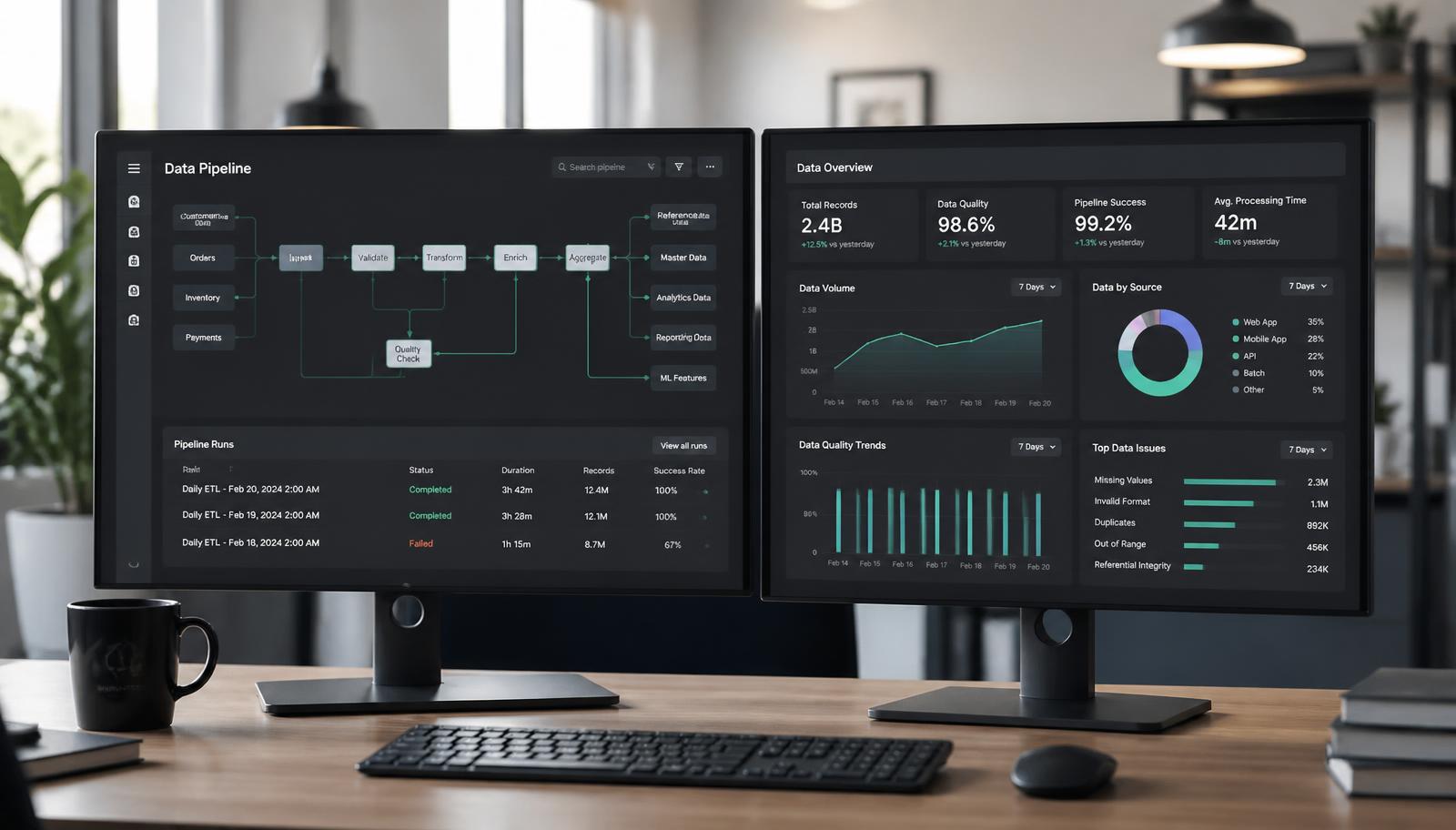
Databricks and Snowflake are the two platforms that dominate almost every modern data platform shortlist. They started from opposite ends — Databricks from Apache Spark and data engineering, Snowflake from the cloud data warehouse — and have been converging ever since. That convergence is exactly why the choice has become harder: on paper both can do everything.
This guide compares them on the criteria that actually decide the outcome: architecture, cost model, governance, AI and machine learning, skills, and migration effort.
Databricks vs Snowflake at a glance
| Criterion | Databricks | Snowflake |
|---|---|---|
| Origin | Spark, data engineering, ML | Cloud data warehouse, SQL analytics |
| Architecture | Lakehouse on your own object storage (Delta Lake) | Managed storage with compute separated into virtual warehouses |
| Primary language | Python, Scala, SQL, notebooks | SQL first, Python via Snowpark |
| Governance | Unity Catalog | Horizon / built-in RBAC and masking |
| Cost model | DBU per compute type, plus cloud infrastructure | Credits per warehouse size and runtime |
| Sweet spot | Large-scale engineering, streaming, AI and ML | BI, reporting, data sharing, SQL-heavy teams |
| Operational effort | Higher: more knobs, more power | Lower: opinionated and largely hands-off |
1. Architecture: lakehouse versus managed warehouse
Databricks stores data as open table formats (Delta Lake, increasingly Iceberg) in your own cloud object storage. You keep the files, the platform provides the engine and the catalogue. That openness matters if you want multiple engines on the same data, or if exit risk is a board-level concern.
Snowflake historically stores data in its own managed format. You trade some control for a lot of operational simplicity: no cluster tuning, no file compaction strategy, no Spark configuration. Iceberg tables have narrowed the gap, but the platform experience is still warehouse-first.
Rule of thumb: if your workloads are mostly structured and SQL-driven, the warehouse model removes work. If you handle semi-structured data, streaming, images, text and model training, the lakehouse model removes constraints.
2. Cost: neither is cheaper by default
Comparisons that declare a winner on price are almost always comparing a well-tuned setup with a badly tuned one. Both platforms bill for compute time; both get expensive the same way — idle warehouses, oversized clusters, unpartitioned tables, dashboards refreshing every five minutes on data that changes daily.
- Snowflake tends to be cheaper for spiky BI workloads thanks to per-second billing, auto-suspend and result caching.
- Databricks tends to be cheaper for heavy transformation and ML, because you control instance types, spot capacity and job clusters.
- Both reward the same discipline: incremental models, right-sized compute, workload isolation and hard budget alerts from day one.
Model your three heaviest workloads on both platforms before signing anything. A two-week proof of concept on real data beats any benchmark deck.
3. Governance and compliance
For European organisations, governance is often the deciding factor. Both offer role-based access control, column and row-level security, masking, lineage and audit logs. Unity Catalog gives you one governance layer across files, tables, models and dashboards, which is valuable when AI assets need the same controls as tables. Snowflake''s model is simpler to reason about and easier to hand to a small platform team.
Check the specifics that regulators care about: data residency per region, bring-your-own-key encryption, retention of audit trails, and how lineage is exposed to your data protection officer.
4. AI and machine learning workloads
This is where the platforms still differ most. Databricks was built for the full model lifecycle: feature engineering, MLflow tracking, model registry, serving endpoints, and increasingly LLM and vector workloads on the same governed data. Snowflake covers a growing part of that with Snowpark, Cortex and native vector functions, and it is more than enough for forecasting, scoring and embedding search close to your warehouse.
If AI is a core product capability rather than an analytics add-on, Databricks usually shortens the path from experiment to production.
5. Skills and team fit
The platform your team can actually operate wins. A team of analytics engineers working in SQL and dbt will be productive on Snowflake in days. A team of Python-first data engineers will find Databricks natural and Snowflake restrictive. Migration cost is rarely the licence — it is the retraining, the rewritten pipelines and the six months of dual running.
6. When to choose which
Choose Snowflake if
- Your workloads are mostly BI, reporting and SQL transformations
- You have a small platform team and want low operational overhead
- Secure data sharing with partners or customers is a core use case
Choose Databricks if
- You run large-scale batch or streaming pipelines
- Machine learning and AI products are on the roadmap, not just dashboards
- You want open table formats and multi-engine access to your own storage
Choose both if
Plenty of larger organisations run Databricks for engineering and AI and Snowflake for serving business users. That is a legitimate architecture — provided you define one source of truth, one governance model and a clear rule for where a dataset lives. Without that, you pay twice and trust neither.
A decision framework you can run in two weeks
- List your five most important workloads and label each as BI, transformation, streaming or ML.
- Define the non-negotiables: residency, encryption, existing tooling, in-house skills.
- Build the same three pipelines on both platforms with production-like volumes.
- Measure cost per run, time to first insight, and how long onboarding a new engineer takes.
- Score against the non-negotiables first, cost second. Speed of delivery is usually worth more than a 10% compute difference.
Frequently asked questions
Is Databricks cheaper than Snowflake?
Not inherently. Databricks is often cheaper for heavy transformation and ML workloads where you control the cluster; Snowflake is often cheaper for spiky BI usage thanks to auto-suspend and caching. Tuning matters more than the price list.
Can Snowflake replace a data lake?
For structured and semi-structured data, largely yes, and Iceberg support lets you keep data in your own storage. For unstructured data and large-scale model training, a lakehouse is still the better fit.
Can you migrate from one to the other?
Yes, but the effort sits in pipelines and orchestration, not in the tables. Budget for rewriting transformations, re-implementing access control and running both platforms in parallel during validation.
Which is better for AI?
Databricks for the full model lifecycle and custom AI products; Snowflake for AI features close to your warehouse data with minimal operational overhead.
Getting the decision right
There is no universally better platform — only a better fit for your workloads, your team and your compliance requirements. Our data engineers help organisations run this comparison objectively, including cost modelling and a working proof of concept on your own data.
Ready to get more value from your data?
We design and build data platforms, pipelines and dashboards your teams can rely on.
Explore Data & AIFrequently Asked Questions
Have questions about this topic? Here are the most frequently asked questions.